Maine Coon Cat product reviews...
As time progresses with this blog about Maine Coon Cats I will be completing reviews of products that are available on the market today.
I promise to be completely unbiased in any reviews that I provide for you.
If you know of any product that you believe are of great benefit to Maine Coon Cat owners or cat owners in general please post your information here for all to see.
Together we will create a fantastic blog packed with information and genuine reviews for all to see.
Monday, 5 May 2008


What is your biggest problem / question about Maine Coon Cats?
What is your biggest problem with Maine Coon Cats?
I am currently researching Maine Coon Cats and the problems that their owners have with them, I would greatly appreciate information from you!When you click on the link below you will be able to answer a simple 1 question survey asking;What is your biggest problem / question about Maine Coon Cats?
Click here to take survey
Your help is greatly appreciated in this matter.
Thanks,
Adam
I am currently researching Maine Coon Cats and the problems that their owners have with them, I would greatly appreciate information from you!When you click on the link below you will be able to answer a simple 1 question survey asking;What is your biggest problem / question about Maine Coon Cats?
Click here to take survey
Your help is greatly appreciated in this matter.
Thanks,
Adam
My reviews of Maine Coon Cat sites
My reviews.........
As I write this blog I will be constantly reviewing other related sites, these sites will be specifically about Maine Coon Cats.
I will also be providing information about some great forums and discussion groups.
If I have information that I believe will be of use to you and your Maine Coon I will post it on this blog for everyone to see.
If you know of a great site, either about maine Coon Cats or cats in general then you too can leave a review of it, hopefully we can all help each other by providing valuable information for all owners of Maine Coon Cats to use.
Sunday, 4 May 2008
Helath care for your Maine Coon Cat
Maine Coon Cat Health Considerations
No one likes to think their beloved Maine Coon cat could be taken ill and possibly die suddenly. Unfortunately, Maine Coon cats do have a track record as a breed for hypertrophic cardiomyopathy (HCM). This is a common disease in cats, but seems to be more prevalent in Maine Coons. Recent goods news indicates that a gene mutation (linked to sarcomeric proteins) found in Maine Coon cats is related to HCM, and it is good news because once identified there is the potential to save lives.
HCM is the leading cause of sudden death for indoor adult cats. The cardiac myosin binding protein C is not correctly incorporated into the heart muscle of the Maine Coon cats with HCM. Were there any symptoms prior to the unexpected death? Usually no, it just happens which makes it all the more difficult to deal with. It is sometimes diagnosed in cats as a result of something like a blood clot that produces symptoms of a stroke. Although this can be treated, the strokes will continue and get worse. There are drugs that can be used in situations where the cat has been diagnosed with HCM, however they seem to be producing mixed results at best.
Hypertrophic cardiomyopathy is when the left chamber of the heart thickens. Because the chamber is thicker, it causes the heart to work harder. It occasionally can be diagnosed if the Veterinarian hears a heart murmur or a very rapid heartbeat. Keep in mind though that these symptoms can also mean something else. HCM can be identified using ultra-sound. By the way the Maine Coon cat is not the only one with this gene anomaly. It also shows up in the American Shorthair, Devon Rex, Persian, and Ragdoll.
How do these findings affect breeding? Good question. Since HCM doesn't show up until the cats are older, it's almost impossible to weed out HCM carriers. They may enter adulthood having already sired several litters, and then it's discovered they have HCM. By then the genes have likely been passed on to other generations. With the ability to now identify the gene in a Maine Coon cat, the hope is that a test can pinpoint carriers of this disease in kittens. This may also result in the creation of a drug to intervene.
Another disease you should be aware of in your Maine Coon cat is spinal muscular atrophy. The genetic cause of this was tracked in 2005 and because of this break through there is now an easy and highly reliable DNA carrier test.
Spinal muscular atrophy is the result of the death of spinal cord neurons that send signals to the trunk and limb muscles. This can been seen as early as 3 months in youngsters that develop an odd swaying gait of the hindquarters and in how they stand with their hocks just about touching. At about 5 months they are too weak to jump and any landings attempted are clumsy. These kittens, and later as adults, are not in pain, eat and play well and live relatively long, good lives as indoor cats.
How does this affect a breeding program? Spinal muscular atrophy is inherited by acquiring the gene from both parents. It is known as a simple autosomal recessive trait and it affects male and female kittens equally. The problem is the parents don't show signs of the disease, but are classified as carriers. So, if a carrier is not identified, they could pass this trait on. To identify a carrier DNA is collected from cat cheek cells, blood or frozen semen. You can do this strictly confidential test by contacting a lab directly to submit samples.
Your Maine Coon cat may also contract polycystic kidney disease – an irreversible, inherited disorder once thought to happen only in Persians and Persian related cats. It does not show up until later in life – usually around the age of seven or so. Polycystic kidney disease causes renal failure and can be identified through several signs. Watch for depression, a reduced appetite, more frequent drinking and urination, loss of weight and bouts of vomiting.
Treatment for this is the same as treatment for chronic kidney failure and involves a restricted protein and phosphorus diet, phosphorus binders, Vitamin D and Erythropoietin. In some cases your vet will use subcutaneous fluids.
Watch for hip dysplasia that may affect one or both hips. This is another inherited trait involving multiple gene pairs – meaning both parents have hip dysplasia or carry the genes for it. This condition develops over time due to an improperly fitting femoral head into the hip socket and eventually causes osteoarthritis.
Can regular vet visits help maintain the health of your Maine Coon cat? Yes they can, and we encourage you to take your special pet for an exam if you have any health concerns at all.
No one likes to think their beloved Maine Coon cat could be taken ill and possibly die suddenly. Unfortunately, Maine Coon cats do have a track record as a breed for hypertrophic cardiomyopathy (HCM). This is a common disease in cats, but seems to be more prevalent in Maine Coons. Recent goods news indicates that a gene mutation (linked to sarcomeric proteins) found in Maine Coon cats is related to HCM, and it is good news because once identified there is the potential to save lives.
HCM is the leading cause of sudden death for indoor adult cats. The cardiac myosin binding protein C is not correctly incorporated into the heart muscle of the Maine Coon cats with HCM. Were there any symptoms prior to the unexpected death? Usually no, it just happens which makes it all the more difficult to deal with. It is sometimes diagnosed in cats as a result of something like a blood clot that produces symptoms of a stroke. Although this can be treated, the strokes will continue and get worse. There are drugs that can be used in situations where the cat has been diagnosed with HCM, however they seem to be producing mixed results at best.
Hypertrophic cardiomyopathy is when the left chamber of the heart thickens. Because the chamber is thicker, it causes the heart to work harder. It occasionally can be diagnosed if the Veterinarian hears a heart murmur or a very rapid heartbeat. Keep in mind though that these symptoms can also mean something else. HCM can be identified using ultra-sound. By the way the Maine Coon cat is not the only one with this gene anomaly. It also shows up in the American Shorthair, Devon Rex, Persian, and Ragdoll.
How do these findings affect breeding? Good question. Since HCM doesn't show up until the cats are older, it's almost impossible to weed out HCM carriers. They may enter adulthood having already sired several litters, and then it's discovered they have HCM. By then the genes have likely been passed on to other generations. With the ability to now identify the gene in a Maine Coon cat, the hope is that a test can pinpoint carriers of this disease in kittens. This may also result in the creation of a drug to intervene.
Another disease you should be aware of in your Maine Coon cat is spinal muscular atrophy. The genetic cause of this was tracked in 2005 and because of this break through there is now an easy and highly reliable DNA carrier test.
Spinal muscular atrophy is the result of the death of spinal cord neurons that send signals to the trunk and limb muscles. This can been seen as early as 3 months in youngsters that develop an odd swaying gait of the hindquarters and in how they stand with their hocks just about touching. At about 5 months they are too weak to jump and any landings attempted are clumsy. These kittens, and later as adults, are not in pain, eat and play well and live relatively long, good lives as indoor cats.
How does this affect a breeding program? Spinal muscular atrophy is inherited by acquiring the gene from both parents. It is known as a simple autosomal recessive trait and it affects male and female kittens equally. The problem is the parents don't show signs of the disease, but are classified as carriers. So, if a carrier is not identified, they could pass this trait on. To identify a carrier DNA is collected from cat cheek cells, blood or frozen semen. You can do this strictly confidential test by contacting a lab directly to submit samples.
Your Maine Coon cat may also contract polycystic kidney disease – an irreversible, inherited disorder once thought to happen only in Persians and Persian related cats. It does not show up until later in life – usually around the age of seven or so. Polycystic kidney disease causes renal failure and can be identified through several signs. Watch for depression, a reduced appetite, more frequent drinking and urination, loss of weight and bouts of vomiting.
Treatment for this is the same as treatment for chronic kidney failure and involves a restricted protein and phosphorus diet, phosphorus binders, Vitamin D and Erythropoietin. In some cases your vet will use subcutaneous fluids.
Watch for hip dysplasia that may affect one or both hips. This is another inherited trait involving multiple gene pairs – meaning both parents have hip dysplasia or carry the genes for it. This condition develops over time due to an improperly fitting femoral head into the hip socket and eventually causes osteoarthritis.
Can regular vet visits help maintain the health of your Maine Coon cat? Yes they can, and we encourage you to take your special pet for an exam if you have any health concerns at all.
Physical characteristics of the Maine Coon Cat
Maine Coon Cats Physical Characteristics
One of the more memorable doggerals (pardon the reference to the canine world) about cats is from the ever delightful Dr. Suess's book, Cat in the Hat where we come to know that a "Cat is a Cat and that is that!" Well as lovable as that may be, it's really not true when applied to the Maine Coon cat. This grand fellow is more than a cat, and if you are owned by one, you will know instantly what we mean. The Maine Coon is a bit like a smaller lion in cat's clothing and of course is noted for its superb hunting skills as well.
Maine Coon cats are much larger than the "usual" sized puss and seem to have simply unlimited energy. Would that we could bottle that for ourselves! Your average Maine Coon can weigh up to 25 pounds. Of course there are variations on that rule of thumb. For instance males usually tip the scales at about 13 to 20 pounds, with females between 7 and 11 pounds. Large you say? Just how large are you talking about? Would you believe males can stretch to over 40 inches long? Actually, there are some even longer, with the longest cat in the record books being measured at a whopping 48 inches. Fancy that would you – 48 inches long! Just because they happen to be big cats does not mean they are fully mature. Maine Coon cats really don't come into their own until they're about 4 or 5 years old. Until then, they're kind of like a big kid in a fur coat.
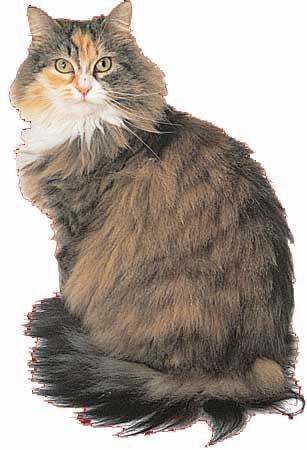
Coonies, a shortened term of affection for the Maine Coon cat, are often brown with tabby markings. However they do come in other colors, and those are officially recognized by the various cat registries and associations. You'll find just about every color including tortoiseshell. You won't however find chocolate, ticked tabby, lavender or anything remotely resembling the Siamese patterns. As for eye color, look for green, gold or green-gold for most of the Maine Coon cats, except in those with white coats. In those with white coats expect to find blue eyes, or china eyes (one blue and one gold eye).
This is a lovely story that brings a smile to your face. The distinctive "M" shaped marking on their forehead is one of the first things people recognize, after they've noticed their eyes. That "M" is said to have its origins in the stable birthplace of baby Jesus. Mary was so thankful to the cat who helped her and kept her company in the barn, that she inscribed her initial "M" on its forehead, and that mark has remained until this day.
Maine Coon cats have dense fur and a lovely ruff on their chests, and one of the things you will notice as well is their stately, yet mischevious attitudes. Their fur is two layered with an undercoat and the additional layer being guard hairs. Of course this not only makes their coat distinctive but ensures soft fur. Like horses (who have feathers down their legs), the Coonies have long hair on the backs of their legs called pantaloons or britches. If you take a look between their toes, you'll also note long hair to help them keep warm in the winter.
Those appealing tufted ears (known as lynx-tips) are so striking, they just set off the whole face and give it an abundance of character. Right, just what they need, more character! J The ears are quite the focal point of the squared-off muzzles set jauntily on angular heads. And you certainly must know all about their famous tails – bushy and plumed and almost twice the size of what would be considered a normal tail on any other cat. They use this wicked tail to wrap around their faces and noses to keep warm.
No matter what you choose to call this very special cat, the Maine Coon cat is a very popular addition to any home. And even though they have a lot of fur, their grooming is minimal since they take care of that themselves.
If you have enjoyed this article about the characteristics of your Maine Coon Cat then please feel free to reprint it as it is. This resource box must be included with the article. Please visit and link to my blog at http://www.world-of-maine-coon-cats.blogspt.com/.
One of the more memorable doggerals (pardon the reference to the canine world) about cats is from the ever delightful Dr. Suess's book, Cat in the Hat where we come to know that a "Cat is a Cat and that is that!" Well as lovable as that may be, it's really not true when applied to the Maine Coon cat. This grand fellow is more than a cat, and if you are owned by one, you will know instantly what we mean. The Maine Coon is a bit like a smaller lion in cat's clothing and of course is noted for its superb hunting skills as well.
Maine Coon cats are much larger than the "usual" sized puss and seem to have simply unlimited energy. Would that we could bottle that for ourselves! Your average Maine Coon can weigh up to 25 pounds. Of course there are variations on that rule of thumb. For instance males usually tip the scales at about 13 to 20 pounds, with females between 7 and 11 pounds. Large you say? Just how large are you talking about? Would you believe males can stretch to over 40 inches long? Actually, there are some even longer, with the longest cat in the record books being measured at a whopping 48 inches. Fancy that would you – 48 inches long! Just because they happen to be big cats does not mean they are fully mature. Maine Coon cats really don't come into their own until they're about 4 or 5 years old. Until then, they're kind of like a big kid in a fur coat.
Coonies, a shortened term of affection for the Maine Coon cat, are often brown with tabby markings. However they do come in other colors, and those are officially recognized by the various cat registries and associations. You'll find just about every color including tortoiseshell. You won't however find chocolate, ticked tabby, lavender or anything remotely resembling the Siamese patterns. As for eye color, look for green, gold or green-gold for most of the Maine Coon cats, except in those with white coats. In those with white coats expect to find blue eyes, or china eyes (one blue and one gold eye).
This is a lovely story that brings a smile to your face. The distinctive "M" shaped marking on their forehead is one of the first things people recognize, after they've noticed their eyes. That "M" is said to have its origins in the stable birthplace of baby Jesus. Mary was so thankful to the cat who helped her and kept her company in the barn, that she inscribed her initial "M" on its forehead, and that mark has remained until this day.
Maine Coon cats have dense fur and a lovely ruff on their chests, and one of the things you will notice as well is their stately, yet mischevious attitudes. Their fur is two layered with an undercoat and the additional layer being guard hairs. Of course this not only makes their coat distinctive but ensures soft fur. Like horses (who have feathers down their legs), the Coonies have long hair on the backs of their legs called pantaloons or britches. If you take a look between their toes, you'll also note long hair to help them keep warm in the winter.
Those appealing tufted ears (known as lynx-tips) are so striking, they just set off the whole face and give it an abundance of character. Right, just what they need, more character! J The ears are quite the focal point of the squared-off muzzles set jauntily on angular heads. And you certainly must know all about their famous tails – bushy and plumed and almost twice the size of what would be considered a normal tail on any other cat. They use this wicked tail to wrap around their faces and noses to keep warm.
No matter what you choose to call this very special cat, the Maine Coon cat is a very popular addition to any home. And even though they have a lot of fur, their grooming is minimal since they take care of that themselves.
If you have enjoyed this article about the characteristics of your Maine Coon Cat then please feel free to reprint it as it is. This resource box must be included with the article. Please visit and link to my blog at http://www.world-of-maine-coon-cats.blogspt.com/.
Behavior of the Maine Coon Cat
Maine Coon Cat and Behavioral Characteristics
The Maine Coon cat has a variety of names, many that aren't really used that much any more, but we're going to share them with you in case you happen to run across other names in your research. Those other names are: American Coon Cat, Maine Cat, Maine Trick Cat, American Longhair, American Forest Cat, American Shag, American Snughead and don't forget Coonie. This particular cat is totally adored by many and for good reasons. The major one is their intelligence.
Maine Coon cats display a very high level of intelligence and can actually be trained much like a dog. Ok they don't always come when you call, but they can be taught tricks and some will even play fetch with you. With a high IQ like this, you want to make sure you train the cat, not the other way around. Being blessed with a mischievous sense of humor and boundless energy, you can count on the Maine Coon cat to want to play with you. Try teaching them how to play catch. Their enormous front paws, even if they aren't polydactyls, give them a great deal of dexterity.
Just watch your cat curl its paw over an object and then pick it up. They can and do manage to open cupboard doors and go in to explore. And, if you happen to have a tap that is fairly easy to turn on, give your cat enough time and he'll learn how to turn it on. Remarkable cats, Maine Coons have also been known to eat with their paws instead of out of their bowls. Resist the urge to offer them their own fork.
If you haven't heard a Maine Coon cat talk to you, you'll be in for a bit of a surprise. Rather than offer the standard feline greeting of "rowl" or "meow" they come out with a mixed purr/trill crossed with a meow. It's quite amazing to listen to, as it seems to convey a whole story in one short trill. What will amuse you no end, is when they (you will have more than one Maine Coon cat once you start loving them) start playing and trilling while running through the house at top speed at 3:00 am. Their games of hide and seek in the nocturnal hours are really quite hysterical, so long as you have a sense of humor.
Don't be too surprised to find your Maine Coon cat in the bathtub, especially if you have a leaking tap. While they won't get under the tap to play in it, they will play with the drips with rapt fascination. Then when bored with that game they may take a drink from the tap despite the fact they have their own bowl of water out in the kitchen. Totally irrepressible these characters! Watch them dip their toys into water, and keep the toilet seat down – they've been known to drop things in the water and then try and fish them out. Another rather quirky trait they have is eyeing a bowl of water like it had a snake in it, then before taking a drink will skim their paws across the top of the water. Of course they then flip the water all over the floor when they shake it out of their paw.
Try to keep your Maine Coon cat well exercised and entertained. Why? Aside from the bonding aspect of this routine, they do get bored from time to time. And what does a bored Maine Coon cat do? Hops up on a table, the fridge or your desk and pushes things off over the edge using their large paws. Awww, gotta love them!
Aside from keeping them entertained, maybe you could also cuddle with them in your lap. Well, nice thought, but they're not really considered to be lap cats. Maine Coon cats are highly independent. That's not to say they don't adore their humans, it's just that they like to do their own thing with humans. And that usually means following them around the house and sitting by them, but not on them. So you won't find your cat begging for attention, but he will be a constant shadow, happy to be near you.
If you have enjoyed this article about the behavior of your Maine Coon Cat then please feel free to reprint it as it is. This resource box must be included with the article. Please visit and link to my blog at www.world-of-maine-coon-cats.blogspot.com.
The Maine Coon cat has a variety of names, many that aren't really used that much any more, but we're going to share them with you in case you happen to run across other names in your research. Those other names are: American Coon Cat, Maine Cat, Maine Trick Cat, American Longhair, American Forest Cat, American Shag, American Snughead and don't forget Coonie. This particular cat is totally adored by many and for good reasons. The major one is their intelligence.
Maine Coon cats display a very high level of intelligence and can actually be trained much like a dog. Ok they don't always come when you call, but they can be taught tricks and some will even play fetch with you. With a high IQ like this, you want to make sure you train the cat, not the other way around. Being blessed with a mischievous sense of humor and boundless energy, you can count on the Maine Coon cat to want to play with you. Try teaching them how to play catch. Their enormous front paws, even if they aren't polydactyls, give them a great deal of dexterity.
Just watch your cat curl its paw over an object and then pick it up. They can and do manage to open cupboard doors and go in to explore. And, if you happen to have a tap that is fairly easy to turn on, give your cat enough time and he'll learn how to turn it on. Remarkable cats, Maine Coons have also been known to eat with their paws instead of out of their bowls. Resist the urge to offer them their own fork.
If you haven't heard a Maine Coon cat talk to you, you'll be in for a bit of a surprise. Rather than offer the standard feline greeting of "rowl" or "meow" they come out with a mixed purr/trill crossed with a meow. It's quite amazing to listen to, as it seems to convey a whole story in one short trill. What will amuse you no end, is when they (you will have more than one Maine Coon cat once you start loving them) start playing and trilling while running through the house at top speed at 3:00 am. Their games of hide and seek in the nocturnal hours are really quite hysterical, so long as you have a sense of humor.
Don't be too surprised to find your Maine Coon cat in the bathtub, especially if you have a leaking tap. While they won't get under the tap to play in it, they will play with the drips with rapt fascination. Then when bored with that game they may take a drink from the tap despite the fact they have their own bowl of water out in the kitchen. Totally irrepressible these characters! Watch them dip their toys into water, and keep the toilet seat down – they've been known to drop things in the water and then try and fish them out. Another rather quirky trait they have is eyeing a bowl of water like it had a snake in it, then before taking a drink will skim their paws across the top of the water. Of course they then flip the water all over the floor when they shake it out of their paw.
Try to keep your Maine Coon cat well exercised and entertained. Why? Aside from the bonding aspect of this routine, they do get bored from time to time. And what does a bored Maine Coon cat do? Hops up on a table, the fridge or your desk and pushes things off over the edge using their large paws. Awww, gotta love them!
Aside from keeping them entertained, maybe you could also cuddle with them in your lap. Well, nice thought, but they're not really considered to be lap cats. Maine Coon cats are highly independent. That's not to say they don't adore their humans, it's just that they like to do their own thing with humans. And that usually means following them around the house and sitting by them, but not on them. So you won't find your cat begging for attention, but he will be a constant shadow, happy to be near you.
If you have enjoyed this article about the behavior of your Maine Coon Cat then please feel free to reprint it as it is. This resource box must be included with the article. Please visit and link to my blog at www.world-of-maine-coon-cats.blogspot.com.
Maine Coon Cat History
Maine Coon Cat History
The Maine Coon has a really rich and colorful history that many people don't always take the time to appreciate. They are said to be the oldest "natural" (meaning bred without selective interference) breed in North America and are considered to be native to the state of Maine. Did you know the Maine Coon cat is actually the official Maine State cat? They were also known to be the darlings of the rural world where they dominated in the vermin-hunting arena. Many a farmer was mightily impressed with their hunting skills.
Where did this stupendously attractive and intelligent puss come from in the first place? There are many theories, myths and other forms of speculation that never really get right to the bottom of their origin. The most famous myth being the Maine Coon cat is called that because it mated with a raccoon. Not! It is just not physically possible for that to happen. However you can see by looking at the cat's lovely, luxurious coon like tail and their usual coloring (striped like a raccoon and brown) why the myth got started in the first place. Once upon a time only the brown fellows were called Maine Coon cats. Others were referred to as Maine Shags, mainly due to their rugged coats.
As far as myths go there is another one floating around that has Marie Antoinette sending six cats to Wiscasset, Maine prior to trying to flee France during the Revolution. Interesting story, but not likely true either. Most breeders are firmly convinced that the Maine Coon cat is the result of breeding between shorthaired domestic felines and longhairs that arrived in the country from overseas. How did the longhairs get here? The story goes the longhairs were introduced to America by the Vikings. And, if you look at Norwegian Forest cats, you might just agree with that theory. But it would also make sense if New England seamen introduced the shorthairs to the longhairs.
As delightful as the myths may be, what seems to be the most important point is the Maine Coon cat has a venerable show history. In fact, as far back as 1861 Maine Coons were much admired show competitors in New York and Boston. These darlings of the show world lost favor when their longhaired competitors, the Persians came onto the scene. Knocked off their popularity perch in the 1900's Maine Coons didn't come back into vogue until the 1950's when they hit the show circuit with a vengeance and their pedigrees started being documented.
It wasn't until 1968 that an association was formed to preserve and protect the Maine Coon cat breed. So thanks to a handful of breeders the Maine Coon Breeders and Fanciers Association was born with one of its tasks being to promote recognition for this breed. They did a remarkable job and the cat was firmly ensconced in all registries across the United States.
Of interest is a recent development in the Maine Coon cat world, planned breeding. This is interesting because once this task was solely left up to the auspices of Mother Nature. Planned breeding can also mean breeding to rule out or include particular traits. Having said that, rest easy, as the breed is being preserved for its original qualities, and one of those particular qualities is its natural ruggedness.
This is one strong and really healthy feline that has remained untouched in appearance since its beginnings. In fact there are some who would likely mistake them for moggies, but on an up close and personal inspection would realize their mistake. Moggies or mog usually refers to cats of an undistinguished type, sort of like a Heinz 57 dog. It is also an affectionate term of endearment for domesticated cats.
No matter what you choose to call your Maine Coon cat, always refer to it as exceedingly special, for they are. These delightful creatures can steal your heart away with just one glance, and if you only have one Maine Coon, you will soon have more.
If you have enjoyed this article about the history of the Maine Coon Cat then please feel free to reprint it as it is. This resource box must be included with the article. Please visit and link to my blog at http://www.world-of-maine-coon-cats.blogspt.com/.
The Maine Coon has a really rich and colorful history that many people don't always take the time to appreciate. They are said to be the oldest "natural" (meaning bred without selective interference) breed in North America and are considered to be native to the state of Maine. Did you know the Maine Coon cat is actually the official Maine State cat? They were also known to be the darlings of the rural world where they dominated in the vermin-hunting arena. Many a farmer was mightily impressed with their hunting skills.
Where did this stupendously attractive and intelligent puss come from in the first place? There are many theories, myths and other forms of speculation that never really get right to the bottom of their origin. The most famous myth being the Maine Coon cat is called that because it mated with a raccoon. Not! It is just not physically possible for that to happen. However you can see by looking at the cat's lovely, luxurious coon like tail and their usual coloring (striped like a raccoon and brown) why the myth got started in the first place. Once upon a time only the brown fellows were called Maine Coon cats. Others were referred to as Maine Shags, mainly due to their rugged coats.
As far as myths go there is another one floating around that has Marie Antoinette sending six cats to Wiscasset, Maine prior to trying to flee France during the Revolution. Interesting story, but not likely true either. Most breeders are firmly convinced that the Maine Coon cat is the result of breeding between shorthaired domestic felines and longhairs that arrived in the country from overseas. How did the longhairs get here? The story goes the longhairs were introduced to America by the Vikings. And, if you look at Norwegian Forest cats, you might just agree with that theory. But it would also make sense if New England seamen introduced the shorthairs to the longhairs.
As delightful as the myths may be, what seems to be the most important point is the Maine Coon cat has a venerable show history. In fact, as far back as 1861 Maine Coons were much admired show competitors in New York and Boston. These darlings of the show world lost favor when their longhaired competitors, the Persians came onto the scene. Knocked off their popularity perch in the 1900's Maine Coons didn't come back into vogue until the 1950's when they hit the show circuit with a vengeance and their pedigrees started being documented.
It wasn't until 1968 that an association was formed to preserve and protect the Maine Coon cat breed. So thanks to a handful of breeders the Maine Coon Breeders and Fanciers Association was born with one of its tasks being to promote recognition for this breed. They did a remarkable job and the cat was firmly ensconced in all registries across the United States.
Of interest is a recent development in the Maine Coon cat world, planned breeding. This is interesting because once this task was solely left up to the auspices of Mother Nature. Planned breeding can also mean breeding to rule out or include particular traits. Having said that, rest easy, as the breed is being preserved for its original qualities, and one of those particular qualities is its natural ruggedness.
This is one strong and really healthy feline that has remained untouched in appearance since its beginnings. In fact there are some who would likely mistake them for moggies, but on an up close and personal inspection would realize their mistake. Moggies or mog usually refers to cats of an undistinguished type, sort of like a Heinz 57 dog. It is also an affectionate term of endearment for domesticated cats.
No matter what you choose to call your Maine Coon cat, always refer to it as exceedingly special, for they are. These delightful creatures can steal your heart away with just one glance, and if you only have one Maine Coon, you will soon have more.
If you have enjoyed this article about the history of the Maine Coon Cat then please feel free to reprint it as it is. This resource box must be included with the article. Please visit and link to my blog at http://www.world-of-maine-coon-cats.blogspt.com/.
Subscribe to:
Posts (Atom)