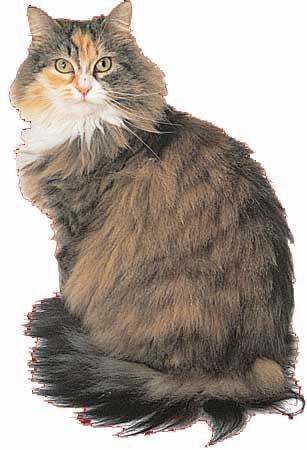
Maine Coon Cat Facts.
The Maine Coon Breeders and Fanciers’ Association (MCBFA) details below their opinion of the ideal Maine Coon Cat. I have listed these Maine Coon Cat Facts below and these are the standards set by the MCBFA and are the bench mark standard for the Maine Coons of today.
Maine Coon Cat Facts;
General Statement: The Maine Coon Cat is a solid, rugged cat and is America’s oldest natural long haired breed. Type must not be sacrificed for size, nor size for type, the optimum being a large typey cat. Females are somewhat smaller that males and allowance should be made for the slow maturation of the breed.
Head: The head of the Maine Coon Cat is medium in length and width, with a squareness to the muzzle. Allowance should be made for broadening in males. Cheekbones should be high. The nose is medium in length and gentle, concave curve and no break or bump. The chin is firm and in line with the upper lip and nose.
Eyes: The eyes of the Maine Coon Cat should be large, wide set and slightly oblique in setting. Eye colour can be shades of green, gold or copper, although white cats may be blue or odd eyed. There is no relationship between eye colour and coat colour. Clarity of eye colour is desirable.
Ears: Large, wide at the base, moderately pointed and well tufted, the ears should be set high on the head approximately as ear’s width apart. Lynx like tipping is desirable.
Body: Muscular, medium to large in size and broad chested, the body is long, with all parts in proportion, creating a rectangular appearance. When viewed from the rear, there is a definite squareness to the rump. The neck is medium to long.
Legs and paws: The legs should be substantial, wide set and medium in length, contributing to a rectangular appearance. The paws should be large, round and well tufted (five toes in front, four in back).
Tail: The tail is long, equal to the body in length (measuring the distance from the end of the rump to the shoulders), wide at the base and tapering. The fur is full, long and flowing.
Coat: The fur on the shoulders is short, gradually increasing in length along the back and sides, ending in full britches and long shaggy belly fur. The fur is soft but has body, falls smoothly and lies close to the body. A slight undercoat is carried. A full ruff is not expected; however, there should be a frontal ruff beginning at the base of the ears.
Coat colour: All recognised colours. White trim around the chin and lip is permitted, except in solid colour cats.
Disqualifications: Markings such as buttons, lockets or spots, overall even coat, short cobby body, crossed eyes, kinked tail and incorrect number of toes are disqualifications.
Penalties: Delicate bone structures, untufted paws, poor condition, a nose break or bump, an undershot chin and a short rounded muzzle.
Conclusion: All the above points are vital to a show cat and to breeders, however, all the points above are open to personal interpretation.For most owners the most important aspect of your Maine Coon is that he is big, strong and healthy with a great temperament.
Showing posts with label maine coon cat facts. Show all posts
Showing posts with label maine coon cat facts. Show all posts
Wednesday, 21 May 2008


Sunday, 4 May 2008
Grooming your Maine Coon Cat
Grooming your Maine Coon Cat
Ever noticed in all your reading about grooming the Maine Coon cat that hardly anyone makes mention of cleaning off those Klingons (and we don't mean those that Captain Kirk fought on Star Trek!) These little hitchhikers are fondly referred to by many names, none polite, and no one likes them hanging from the rear end of their cat. Hard, dried, stuck like glue and tangled in the britches/pantaloons, the feces fiasco frustrates felines
A Maine Coon cat is world famous for their abundantly fuzzy, furry tails – much like a waving flag of confidence. It seems like there is more tail than there is cat! That's why they are often referred to as "the tail with a cat glued to it!" That bushy tail has a myth attached to it about a Maine Coon cat mating with a raccoon. Not true! The term Maine Coon was used to identify them first, and the cat part was tacked on later.
Grooming a Maine Coon cat doesn't have to be done often, as they're very fastidious in the self-cleaning department. If you're showing, that's another story. That means the "B" word and we all know how happy cats are about bathes! Let's assume for the purposes of this article you want to do regular coat maintenance.
For regular coat care for your Maine Coon cat you will do this about twice a week. In your Maine Coon cat care kitty (sorry, couldn't resist the pun) you need a de-matting comb, a grooming rake, a metal comb, clippers, seam ripper, a flea comb, cotton balls, white vinegar, baking soda and a small portable hair dryer with a low setting.
Use the metal comb to get at any tangles and knots. Gently run the comb through them, and start near the end of a tangle, not at the fur near the skin and then pull, that's an "Ouch!" Hold the clump of tangles near to the skin. Holding the fur near the skin will lessen the tugging to get the knots out. If the comb doesn't help you with the knots, use the seam ripper to winnow your way into the heart of the clump and carefully separate the fur.
You next use the grooming rake to take out dead undercoat. The amount of hair you'll get out of your Maine Coon cat will be enough to make a dust bunny the size of a Jack Russell Terrier. Strip this out because it's one of the reasons your cat get those knotty knots. Be careful working on the sensitive tail and tummy.
For your Maine Coon cat's eyes you have two options: eye wipes or a damp cotton ball. When you do wipe their eyes, do not use the same ball/wipe on both eyes. This cuts down on any chances of infection spreading should your cat have an eye inflammation.
The ears can be done two ways as well. You can buy ear wipes at a pet store, or use cotton balls. Some advocate using Q-tips, but this isn't the safest method. If you insert you Q-tip too far into the ear canal, you can cause damage to the eardrums. Use cotton balls instead. For the face, use a warm, damp facecloth and gently wipe the muzzle and mouth area.
Another tip for cleaning Maine Coon cat ears is using apple cider vinegar and water in a 50/50 solution. Mix the solution with warm water, and test it on your wrist first. Dip a cotton ball in and dampen it, not soak it. Clean the inside of the ears with a gentle circling motion. Use the solution once a week. It keeps the environment inside the ear in a balanced Ph and reduces chances of ear infections.
Now, those little dried, icky bits of doo that no matter how many times you comb the fur, they stay adhered to the tail. Here is where the white vinegar comes in. Take a cotton ball and soak it in white vinegar, dab it on the portion of the tail where the doo particles are, then carefully sprinkle baking soda on it. You get instant foam. Put the blow dryer on low heat and dry the baking soda paste until it is hard. Comb it out. Doo be gone! This paste has also been known to whiten fur as well. Just be careful not to get vinegar near their faces or near sensitive private parts.
Your cat may also have something called stud tail, a build up of a brown waxy substance found at the base of the tail. One of the things you can use to clean this is a good hand cleaner, but don't use any product with petroleum or pumice stone. Yellowed areas on the fur from pee dribbles respond well to the white vinegar and baking soda routine.
If you have enjoyed this article about grooming your Maine Coon Cat then please feel free to reprint it as it is. This resource box must be included with the article. Please visit and link to my blog at http://www.world-of-maine-coon-cats.blogspt.com/.
Ever noticed in all your reading about grooming the Maine Coon cat that hardly anyone makes mention of cleaning off those Klingons (and we don't mean those that Captain Kirk fought on Star Trek!) These little hitchhikers are fondly referred to by many names, none polite, and no one likes them hanging from the rear end of their cat. Hard, dried, stuck like glue and tangled in the britches/pantaloons, the feces fiasco frustrates felines
A Maine Coon cat is world famous for their abundantly fuzzy, furry tails – much like a waving flag of confidence. It seems like there is more tail than there is cat! That's why they are often referred to as "the tail with a cat glued to it!" That bushy tail has a myth attached to it about a Maine Coon cat mating with a raccoon. Not true! The term Maine Coon was used to identify them first, and the cat part was tacked on later.
Grooming a Maine Coon cat doesn't have to be done often, as they're very fastidious in the self-cleaning department. If you're showing, that's another story. That means the "B" word and we all know how happy cats are about bathes! Let's assume for the purposes of this article you want to do regular coat maintenance.
For regular coat care for your Maine Coon cat you will do this about twice a week. In your Maine Coon cat care kitty (sorry, couldn't resist the pun) you need a de-matting comb, a grooming rake, a metal comb, clippers, seam ripper, a flea comb, cotton balls, white vinegar, baking soda and a small portable hair dryer with a low setting.
Use the metal comb to get at any tangles and knots. Gently run the comb through them, and start near the end of a tangle, not at the fur near the skin and then pull, that's an "Ouch!" Hold the clump of tangles near to the skin. Holding the fur near the skin will lessen the tugging to get the knots out. If the comb doesn't help you with the knots, use the seam ripper to winnow your way into the heart of the clump and carefully separate the fur.
You next use the grooming rake to take out dead undercoat. The amount of hair you'll get out of your Maine Coon cat will be enough to make a dust bunny the size of a Jack Russell Terrier. Strip this out because it's one of the reasons your cat get those knotty knots. Be careful working on the sensitive tail and tummy.
For your Maine Coon cat's eyes you have two options: eye wipes or a damp cotton ball. When you do wipe their eyes, do not use the same ball/wipe on both eyes. This cuts down on any chances of infection spreading should your cat have an eye inflammation.
The ears can be done two ways as well. You can buy ear wipes at a pet store, or use cotton balls. Some advocate using Q-tips, but this isn't the safest method. If you insert you Q-tip too far into the ear canal, you can cause damage to the eardrums. Use cotton balls instead. For the face, use a warm, damp facecloth and gently wipe the muzzle and mouth area.
Another tip for cleaning Maine Coon cat ears is using apple cider vinegar and water in a 50/50 solution. Mix the solution with warm water, and test it on your wrist first. Dip a cotton ball in and dampen it, not soak it. Clean the inside of the ears with a gentle circling motion. Use the solution once a week. It keeps the environment inside the ear in a balanced Ph and reduces chances of ear infections.
Now, those little dried, icky bits of doo that no matter how many times you comb the fur, they stay adhered to the tail. Here is where the white vinegar comes in. Take a cotton ball and soak it in white vinegar, dab it on the portion of the tail where the doo particles are, then carefully sprinkle baking soda on it. You get instant foam. Put the blow dryer on low heat and dry the baking soda paste until it is hard. Comb it out. Doo be gone! This paste has also been known to whiten fur as well. Just be careful not to get vinegar near their faces or near sensitive private parts.
Your cat may also have something called stud tail, a build up of a brown waxy substance found at the base of the tail. One of the things you can use to clean this is a good hand cleaner, but don't use any product with petroleum or pumice stone. Yellowed areas on the fur from pee dribbles respond well to the white vinegar and baking soda routine.
If you have enjoyed this article about grooming your Maine Coon Cat then please feel free to reprint it as it is. This resource box must be included with the article. Please visit and link to my blog at http://www.world-of-maine-coon-cats.blogspt.com/.
World of Maine Coon Cats
World of Maine Coon Cats
Welcome to the World of Maine Coon Cats, this blog is full of information that you need to know about your Maine Coon Cat.
If you own a Maine Coon Cat then this is the blog for you, add it to your favorites and return often, it will be updated on a regular basis, if you want to know something about your Maine Coon Cat then post your question on the blog and it will be answered.
Subscribe to:
Posts (Atom)