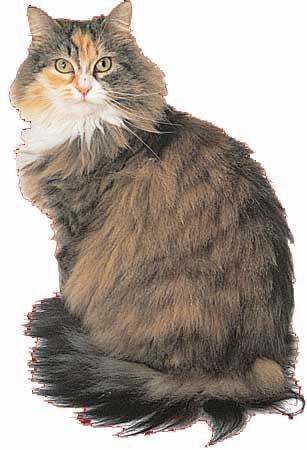
Characteristics of Maine Coon Cats
I have listed below all the key Characteristics of the Maine Coon Cat.
The information about characteristics of Maine Coon cats are the standards set by the MCBFA and are the bench mark standard for the Maine Coons of today.
Characteristics of Maine Coon Cats; - General, Head, Eyes, Ears, Body, Legs and Paws, Coat and Coat Colour.
General Statement: The Maine Coon Cat is a solid, rugged cat and is America’s oldest natural long haired breed. Type must not be sacrificed for size, nor size for type, the optimum being a large typey cat. Females are somewhat smaller that males and allowance should be made for the slow maturation of the breed.
Head: The head of the Maine Coon Cat is medium in length and width, with a squareness to the muzzle. Allowance should be made for broadening in males. Cheekbones should be high. The nose is medium in length and gentle, concave curve and no break or bump. The chin is firm and in line with the upper lip and nose.
Eyes: The eyes of the Maine Coon Cat should be large, wide set and slightly oblique in setting. Eye colour can be shades of green, gold or copper, although white cats may be blue or odd eyed. There is no relationship between eye colour and coat colour. Clarity of eye colour is desirable.
Ears: Large, wide at the base, moderately pointed and well tufted, the ears should be set high on the head approximately as ear’s width apart. Lynx like tipping is desirable.
Body: Muscular, medium to large in size and broad chested, the body is long, with all parts in proportion, creating a rectangular appearance. When viewed from the rear, there is a definite squareness to the rump. The neck is medium to long.
Legs and paws: The legs should be substantial, wide set and medium in length, contributing to a rectangular appearance. The paws should be large, round and well tufted (five toes in front, four in back).Tail: The tail is long, equal to the body in length (measuring the distance from the end of the rump to the shoulders), wide at the base and tapering. The fur is full, long and flowing.
Coat: The fur on the shoulders is short, gradually increasing in length along the back and sides, ending in full britches and long shaggy belly fur. The fur is soft but has body, falls smoothly and lies close to the body. A slight undercoat is carried. A full ruff is not expected; however, there should be a frontal ruff beginning at the base of the ears.
Coat colour: All recognised colours. White trim around the chin and lip is permitted, except in solid colour cats.
For most owners the most important characteristics of Maine Coon Cats is that he is big, strong and healthy with a great temperament.
Wednesday, 21 May 2008


Information about Maine Coon Cat Health
Maine Coon Cat Health
Most Maine Coon Cats are fit and healthy animals, kind natured, gentle and loving. Although illnesses are a problem for all cats and something that a responsible owner should be aware of.
Good nutrition and exercise will all help to keep any Maine Coon Cat healthy, coupled with regular checks at the vet your Maine Coon cat should hopefully never suffer any serious illnesses.
However, all Cats are at risk and the following article outlines some of the possibilites that may occur although they are few and far between.
No one likes to think their beloved Maine Coon Cat could be taken ill and possibly die suddenly. Unfortunately, Maine Coon cats do have a track record as a breed for hypertrophic cardiomyopathy (HCM). This is a common disease in cats, but seems to be more prevalent in Maine Coons.
Recent good news indicates that a gene mutation (linked to sarcomeric proteins) found in Maine Coon cats is related to HCM, and it is good news because once identified there is the potential to save lives.
HCM is the leading cause of sudden death for indoor adult cats. The cardiac myosin binding protein C is not correctly incorporated into the heart muscle of the Maine Coon cats with HCM. Were there any symptoms prior to the unexpected death? Usually no, it just happens which makes it all the more difficult to deal with. It is sometimes diagnosed in cats as a result of something like a blood clot that produces symptoms of a stroke. Although this can be treated, the strokes will continue and get worse.
There are drugs that can be used in situations where the cat has been diagnosed with HCM, however they seem to be producing mixed results at best.
Hypertrophic cardiomyopathy is when the left chamber of the heart thickens. Because the chamber is thicker, it causes the heart to work harder. It occasionally can be diagnosed if the Veterinarian hears a heart murmur or a very rapid heartbeat. Keep in mind though that these symptoms can also mean something else. HCM can be identified using ultra-sound. By the way the Maine Coon cat is not the only one with this gene anomaly. It also shows up in the American Shorthair, Devon Rex, Persian, and Ragdoll.
How do these findings affect breeding? Good question. Since HCM doesn't show up until the cats are older, it's almost impossible to weed out HCM carriers. They may enter adulthood having already sired several litters, and then it's discovered they have HCM. By then the genes have likely been passed on to other generations. With the ability to now identify the gene in a Maine Coon cat, the hope is that a test can pinpoint carriers of this disease in kittens. This may also result in the creation of a drug to intervene.
Another disease you should be aware of in your Maine Coon cat is spinal muscular atrophy. The genetic cause of this was tracked in 2005 and because of this break through there is now an easy and highly reliable DNA carrier test.Spinal muscular atrophy is the result of the death of spinal cord neurons that send signals to the trunk and limb muscles. This can been seen as early as 3 months in youngsters that develop an odd swaying gait of the hindquarters and in how they stand with their hocks just about touching.
At about 5 months they are too weak to jump and any landings attempted are clumsy. These kittens, and later as adults, are not in pain, eat and play well and live relatively long, good lives as indoor cats.
How does this affect a breeding program? Spinal muscular atrophy is inherited by acquiring the gene from both parents. It is known as a simple autosomal recessive trait and it affects male and female kittens equally. The problem is the parents don't show signs of the disease, but are classified as carriers. So, if a carrier is not identified, they could pass this trait on. To identify a carrier DNA is collected from cat cheek cells, blood or frozen semen.
You can do this strictly confidential test by contacting a lab directly to submit samples.Your Maine Coon cat may also contract polycystic kidney disease – an irreversible, inherited disorder once thought to happen only in Persians and Persian related cats.
It does not show up until later in life – usually around the age of seven or so. Polycystic kidney disease causes renal failure and can be identified through several signs. Watch for depression, a reduced appetite, more frequent drinking and urination, loss of weight and bouts of vomiting.Treatment for this is the same as treatment for chronic kidney failure and involves a restricted protein and phosphorus diet, phosphorus binders, Vitamin D and Erythropoietin. In some cases your vet will use subcutaneous fluids.Watch for hip dysplasia that may affect one or both hips. This is another inherited trait involving multiple gene pairs – meaning both parents have hip dysplasia or carry the genes for it. This condition develops over time due to an improperly fitting femoral head into the hip socket and eventually causes osteoarthritis.
Can regular vet visits help maintain the health of your Maine Coon cat? Yes they can, and we encourage you to take your special pet for an exam if you have any health concerns at all.
Most Maine Coon Cats are fit and healthy animals, kind natured, gentle and loving. Although illnesses are a problem for all cats and something that a responsible owner should be aware of.
Good nutrition and exercise will all help to keep any Maine Coon Cat healthy, coupled with regular checks at the vet your Maine Coon cat should hopefully never suffer any serious illnesses.
However, all Cats are at risk and the following article outlines some of the possibilites that may occur although they are few and far between.
No one likes to think their beloved Maine Coon Cat could be taken ill and possibly die suddenly. Unfortunately, Maine Coon cats do have a track record as a breed for hypertrophic cardiomyopathy (HCM). This is a common disease in cats, but seems to be more prevalent in Maine Coons.
Recent good news indicates that a gene mutation (linked to sarcomeric proteins) found in Maine Coon cats is related to HCM, and it is good news because once identified there is the potential to save lives.
HCM is the leading cause of sudden death for indoor adult cats. The cardiac myosin binding protein C is not correctly incorporated into the heart muscle of the Maine Coon cats with HCM. Were there any symptoms prior to the unexpected death? Usually no, it just happens which makes it all the more difficult to deal with. It is sometimes diagnosed in cats as a result of something like a blood clot that produces symptoms of a stroke. Although this can be treated, the strokes will continue and get worse.
There are drugs that can be used in situations where the cat has been diagnosed with HCM, however they seem to be producing mixed results at best.
Hypertrophic cardiomyopathy is when the left chamber of the heart thickens. Because the chamber is thicker, it causes the heart to work harder. It occasionally can be diagnosed if the Veterinarian hears a heart murmur or a very rapid heartbeat. Keep in mind though that these symptoms can also mean something else. HCM can be identified using ultra-sound. By the way the Maine Coon cat is not the only one with this gene anomaly. It also shows up in the American Shorthair, Devon Rex, Persian, and Ragdoll.
How do these findings affect breeding? Good question. Since HCM doesn't show up until the cats are older, it's almost impossible to weed out HCM carriers. They may enter adulthood having already sired several litters, and then it's discovered they have HCM. By then the genes have likely been passed on to other generations. With the ability to now identify the gene in a Maine Coon cat, the hope is that a test can pinpoint carriers of this disease in kittens. This may also result in the creation of a drug to intervene.
Another disease you should be aware of in your Maine Coon cat is spinal muscular atrophy. The genetic cause of this was tracked in 2005 and because of this break through there is now an easy and highly reliable DNA carrier test.Spinal muscular atrophy is the result of the death of spinal cord neurons that send signals to the trunk and limb muscles. This can been seen as early as 3 months in youngsters that develop an odd swaying gait of the hindquarters and in how they stand with their hocks just about touching.
At about 5 months they are too weak to jump and any landings attempted are clumsy. These kittens, and later as adults, are not in pain, eat and play well and live relatively long, good lives as indoor cats.
How does this affect a breeding program? Spinal muscular atrophy is inherited by acquiring the gene from both parents. It is known as a simple autosomal recessive trait and it affects male and female kittens equally. The problem is the parents don't show signs of the disease, but are classified as carriers. So, if a carrier is not identified, they could pass this trait on. To identify a carrier DNA is collected from cat cheek cells, blood or frozen semen.
You can do this strictly confidential test by contacting a lab directly to submit samples.Your Maine Coon cat may also contract polycystic kidney disease – an irreversible, inherited disorder once thought to happen only in Persians and Persian related cats.
It does not show up until later in life – usually around the age of seven or so. Polycystic kidney disease causes renal failure and can be identified through several signs. Watch for depression, a reduced appetite, more frequent drinking and urination, loss of weight and bouts of vomiting.Treatment for this is the same as treatment for chronic kidney failure and involves a restricted protein and phosphorus diet, phosphorus binders, Vitamin D and Erythropoietin. In some cases your vet will use subcutaneous fluids.Watch for hip dysplasia that may affect one or both hips. This is another inherited trait involving multiple gene pairs – meaning both parents have hip dysplasia or carry the genes for it. This condition develops over time due to an improperly fitting femoral head into the hip socket and eventually causes osteoarthritis.
Can regular vet visits help maintain the health of your Maine Coon cat? Yes they can, and we encourage you to take your special pet for an exam if you have any health concerns at all.
Maine Coon Cat Facts
Maine Coon Cat Facts.
The Maine Coon Breeders and Fanciers’ Association (MCBFA) details below their opinion of the ideal Maine Coon Cat. I have listed these Maine Coon Cat Facts below and these are the standards set by the MCBFA and are the bench mark standard for the Maine Coons of today.
Maine Coon Cat Facts;
General Statement: The Maine Coon Cat is a solid, rugged cat and is America’s oldest natural long haired breed. Type must not be sacrificed for size, nor size for type, the optimum being a large typey cat. Females are somewhat smaller that males and allowance should be made for the slow maturation of the breed.
Head: The head of the Maine Coon Cat is medium in length and width, with a squareness to the muzzle. Allowance should be made for broadening in males. Cheekbones should be high. The nose is medium in length and gentle, concave curve and no break or bump. The chin is firm and in line with the upper lip and nose.
Eyes: The eyes of the Maine Coon Cat should be large, wide set and slightly oblique in setting. Eye colour can be shades of green, gold or copper, although white cats may be blue or odd eyed. There is no relationship between eye colour and coat colour. Clarity of eye colour is desirable.
Ears: Large, wide at the base, moderately pointed and well tufted, the ears should be set high on the head approximately as ear’s width apart. Lynx like tipping is desirable.
Body: Muscular, medium to large in size and broad chested, the body is long, with all parts in proportion, creating a rectangular appearance. When viewed from the rear, there is a definite squareness to the rump. The neck is medium to long.
Legs and paws: The legs should be substantial, wide set and medium in length, contributing to a rectangular appearance. The paws should be large, round and well tufted (five toes in front, four in back).
Tail: The tail is long, equal to the body in length (measuring the distance from the end of the rump to the shoulders), wide at the base and tapering. The fur is full, long and flowing.
Coat: The fur on the shoulders is short, gradually increasing in length along the back and sides, ending in full britches and long shaggy belly fur. The fur is soft but has body, falls smoothly and lies close to the body. A slight undercoat is carried. A full ruff is not expected; however, there should be a frontal ruff beginning at the base of the ears.
Coat colour: All recognised colours. White trim around the chin and lip is permitted, except in solid colour cats.
Disqualifications: Markings such as buttons, lockets or spots, overall even coat, short cobby body, crossed eyes, kinked tail and incorrect number of toes are disqualifications.
Penalties: Delicate bone structures, untufted paws, poor condition, a nose break or bump, an undershot chin and a short rounded muzzle.
Conclusion: All the above points are vital to a show cat and to breeders, however, all the points above are open to personal interpretation.For most owners the most important aspect of your Maine Coon is that he is big, strong and healthy with a great temperament.
The Maine Coon Breeders and Fanciers’ Association (MCBFA) details below their opinion of the ideal Maine Coon Cat. I have listed these Maine Coon Cat Facts below and these are the standards set by the MCBFA and are the bench mark standard for the Maine Coons of today.
Maine Coon Cat Facts;
General Statement: The Maine Coon Cat is a solid, rugged cat and is America’s oldest natural long haired breed. Type must not be sacrificed for size, nor size for type, the optimum being a large typey cat. Females are somewhat smaller that males and allowance should be made for the slow maturation of the breed.
Head: The head of the Maine Coon Cat is medium in length and width, with a squareness to the muzzle. Allowance should be made for broadening in males. Cheekbones should be high. The nose is medium in length and gentle, concave curve and no break or bump. The chin is firm and in line with the upper lip and nose.
Eyes: The eyes of the Maine Coon Cat should be large, wide set and slightly oblique in setting. Eye colour can be shades of green, gold or copper, although white cats may be blue or odd eyed. There is no relationship between eye colour and coat colour. Clarity of eye colour is desirable.
Ears: Large, wide at the base, moderately pointed and well tufted, the ears should be set high on the head approximately as ear’s width apart. Lynx like tipping is desirable.
Body: Muscular, medium to large in size and broad chested, the body is long, with all parts in proportion, creating a rectangular appearance. When viewed from the rear, there is a definite squareness to the rump. The neck is medium to long.
Legs and paws: The legs should be substantial, wide set and medium in length, contributing to a rectangular appearance. The paws should be large, round and well tufted (five toes in front, four in back).
Tail: The tail is long, equal to the body in length (measuring the distance from the end of the rump to the shoulders), wide at the base and tapering. The fur is full, long and flowing.
Coat: The fur on the shoulders is short, gradually increasing in length along the back and sides, ending in full britches and long shaggy belly fur. The fur is soft but has body, falls smoothly and lies close to the body. A slight undercoat is carried. A full ruff is not expected; however, there should be a frontal ruff beginning at the base of the ears.
Coat colour: All recognised colours. White trim around the chin and lip is permitted, except in solid colour cats.
Disqualifications: Markings such as buttons, lockets or spots, overall even coat, short cobby body, crossed eyes, kinked tail and incorrect number of toes are disqualifications.
Penalties: Delicate bone structures, untufted paws, poor condition, a nose break or bump, an undershot chin and a short rounded muzzle.
Conclusion: All the above points are vital to a show cat and to breeders, however, all the points above are open to personal interpretation.For most owners the most important aspect of your Maine Coon is that he is big, strong and healthy with a great temperament.
Monday, 19 May 2008
Big Maine Coon Cat

Big Maine Coon Cat - Size of the Maine Coon Cat
The Maine Coon Cat is larger than the average domestic cat but they are not huge as some would have you believe but you can see some very large and big Maine Coon Cats
It is a general misconception that Maine Coons can be as heavy as 30 to 40 lbs, this is simply not true however, they are larger than all other domestic cats.
The average male is between 12 – 20 lbs and the female between 8 – 12 lbs. If your Big Maine Coon weighs considerably more than this it may be due to obesity rather than his natural size, however, some Maine Coons are very large.
To make the size clearer, an average house cat will weigh between 7 – 9 lbs.
Each cat is different and a Maine Coon will not stop growing and developing until 4 to 5 years of age.
Genetics, diet, exercise and general health of the cat all contribute to his size.
The Maine Coon Cat is larger than the average domestic cat but they are not huge as some would have you believe but you can see some very large and big Maine Coon Cats
It is a general misconception that Maine Coons can be as heavy as 30 to 40 lbs, this is simply not true however, they are larger than all other domestic cats.
The average male is between 12 – 20 lbs and the female between 8 – 12 lbs. If your Big Maine Coon weighs considerably more than this it may be due to obesity rather than his natural size, however, some Maine Coons are very large.
To make the size clearer, an average house cat will weigh between 7 – 9 lbs.
Each cat is different and a Maine Coon will not stop growing and developing until 4 to 5 years of age.
Genetics, diet, exercise and general health of the cat all contribute to his size.
The bigger your Maine Conn Cat the more there is to love and hug.
Big Maine Coon Cats Rule.
Friday, 16 May 2008
Keep your Maine Coon Cat off the worktop
Off the Counter Techniques for Your Maine Coon Cat
EEEEK! There he goes again, up on the counter, the fridge, the table, the top of the cupboards and no matter what you've tried so far, nothing works. Don't you just love cats? I mean seriously, they can go wherever they want to, jump as high as they need and can give you that "HA on YOU" look when they're up where they're not supposed to be. You've seen that look, the one that says clearly you've lost your marbles because you're having a fit about them being up on things. The cat on the other hand doesn't see it as being a problem. No kidding!
What can you do? There are a variety of things you can try, but to be honest, many of them work for the short term only and you have to keep reinforcing them. This isn't to say you shouldn't do them, it's a flag saying, you will have to do this more than just once. Cats are not only smart, they're very persistent and if they hopped up on the counter just once and found a treat, they will keep doing it because it paid off for them the first time. Now if you also have a Jack Russell Terrier who likes to climb on the counters – yes ON the counters via the large dog kennel for the Weimaraner, to do the same thing the cats do, then you have a doggedly different problem. However, the solutions may be the same.
The first thing to keep in mind is that cats don't understand punishment of any sort from you the same way a dog does. It just makes them shy of you and smart enough to do the offending behavior when you’re not around. How clever is that anyhow? So you want to actually condition the cat by using the environment around them. That will mean doing things that the cat doesn't associate with you.
Keep the counters clean. If you have empty bowls of yesterday's supper (chicken and rice with sauce) left on the top, guess who will be sticking their nose into it and licking the bowl. Well it won't be your children. So the lesson here is remove all temptations from out of reach of sneaky feet. If it means stashing the goodies in plastic containers, the fridge and in cupboards they can't open or in heavy metal containers, do it. That refers to their goodies. Your goodies you can keep the usual way, but out of the reach of curious paws.
Now speaking of training through the environment. You want something you can use that the cat will not associate with you right? Well, find yourself a squirt gun. Not the big ones that shoot out streams like Victoria Falls, but a light stream. Shoot from a distance and refrain from saying anything like "Ha, got cha!" Most cats don't associate a stream of water with the owner having this weird object in their hands. Will this keep them off the table when you are not home? Maybe yes, maybe no, but you won't know since you aren't there. So this calls for different measures.
Try booby-trapping your counter, and there are several ways to do this as well. One involves loud pop cans with pennies in them. Line them up on the edge of the counter. When your cat jumps up, the cans clatter down around them. Cats hate loud noises and this will keep their feet on the ground for a few days. For this method of be effective you need to do this consistently. Of course there is always the odd puss or two who could care less that they just knocked 6 or 7 noisy objects off the counter. In fact, some just snicker at the prospect of the owner coming home to – 6 cans on the floor and all the pennies scattered under the fridge. (Kidding – you actually tape the holes shut!) At best this crashing clatter will startle them, but will it deter them in the long run? Only time and consistency will tell.
Another home-style remedy for counter surfing is the upside down mousetrap. This idea really would give most owners the collywobbles in case the trap flipped over and nabbed the cat's foot. However, some say it's effective if done the right way. You decide if you want to try this or not. You simply put a mousetrap upside down on the counter, and when the cat lands in the middle of the traps, they'll snap shut and scare him off the counter. Right - watch them land in the only bare spot you have left! Seriously, this method may work with some cats, but it's best to try this only if you are home to rescue your cat if need be.
Speaking of things that "jump up" there is a unique contraption on the market called the Jumpo that might be a better alternative than mousetraps. It's a small wing like contraption that when triggered, jumps up making a clattering noise as it flies into the air. It does not have the risks associated with it that a triggered mousetrap may have. If you want more information on the Jumpo, go here: http://www.jumpotrainer.com/
Try double sided sticky tape on your counters and table. But first make sure it won't stick too badly to your table surface or leave too much glue on the counters. Cats really despise walking on things that grab and stick. Running across this tape would really make them unhappy. Would it keep them off the counter permanently? Depends on how long you want to keep tape on your counters and table.
Tin foil has been known to work because felines they don't like the sound of the crinkling when they land on it. Mind you, we've seen smarty-pants cats go UNDER the foil and explore like it was a tunnel.
There is also a spray you put on your furniture. It's called "No Stay", made by a company called Pet Organics. It's got garlic oil and clove oil in it, but has no smell to humans. As soon as your cat gets on the furniture they would jump right down again. This isn't a smell they like. Usually after about a week they quit jumping up at all. If you want more information on No Stay, go here: http://www.petvetsupply.com/pmsmgar006.html
The best method we could find that will work while you are at home and when you are gone is the SSSCAT. This is a great little device that sprays a harmless, odorless gas from a small container when the cat is within 1 meter of it. The cat's motion triggers the battery operated spray container. It's economical and non-staining, and you can get about 150 sprays out of one can. It usually doesn't take that long for the cat to "get it" though. For more information on SSSCAT go here: http://www.ssscat.com/english/index.html
And don't forget to try out the ScatMat. It lets go with a harmless static pulse when your cat touches it. All your cat does is walks across it and small pulses of electricity move emitting a little "zap". Your cat will learn to stay away from those areas. For more information on this product go here: http://www.safepetproducts.com/pilot.asp?pg=scatmat&gclid=CO_lyaeqkpMCFQKnlgodN1FVgw
If you have enjoyed this article about dealing with aggression and your Maine Coon Cat then please feel free to reprint it as it is. This resource box must be included with the article. Please visit my blog at www.world-of-maine-coon-cats.blogspot.com for lots more free articles and information.
EEEEK! There he goes again, up on the counter, the fridge, the table, the top of the cupboards and no matter what you've tried so far, nothing works. Don't you just love cats? I mean seriously, they can go wherever they want to, jump as high as they need and can give you that "HA on YOU" look when they're up where they're not supposed to be. You've seen that look, the one that says clearly you've lost your marbles because you're having a fit about them being up on things. The cat on the other hand doesn't see it as being a problem. No kidding!
What can you do? There are a variety of things you can try, but to be honest, many of them work for the short term only and you have to keep reinforcing them. This isn't to say you shouldn't do them, it's a flag saying, you will have to do this more than just once. Cats are not only smart, they're very persistent and if they hopped up on the counter just once and found a treat, they will keep doing it because it paid off for them the first time. Now if you also have a Jack Russell Terrier who likes to climb on the counters – yes ON the counters via the large dog kennel for the Weimaraner, to do the same thing the cats do, then you have a doggedly different problem. However, the solutions may be the same.
The first thing to keep in mind is that cats don't understand punishment of any sort from you the same way a dog does. It just makes them shy of you and smart enough to do the offending behavior when you’re not around. How clever is that anyhow? So you want to actually condition the cat by using the environment around them. That will mean doing things that the cat doesn't associate with you.
Keep the counters clean. If you have empty bowls of yesterday's supper (chicken and rice with sauce) left on the top, guess who will be sticking their nose into it and licking the bowl. Well it won't be your children. So the lesson here is remove all temptations from out of reach of sneaky feet. If it means stashing the goodies in plastic containers, the fridge and in cupboards they can't open or in heavy metal containers, do it. That refers to their goodies. Your goodies you can keep the usual way, but out of the reach of curious paws.
Now speaking of training through the environment. You want something you can use that the cat will not associate with you right? Well, find yourself a squirt gun. Not the big ones that shoot out streams like Victoria Falls, but a light stream. Shoot from a distance and refrain from saying anything like "Ha, got cha!" Most cats don't associate a stream of water with the owner having this weird object in their hands. Will this keep them off the table when you are not home? Maybe yes, maybe no, but you won't know since you aren't there. So this calls for different measures.
Try booby-trapping your counter, and there are several ways to do this as well. One involves loud pop cans with pennies in them. Line them up on the edge of the counter. When your cat jumps up, the cans clatter down around them. Cats hate loud noises and this will keep their feet on the ground for a few days. For this method of be effective you need to do this consistently. Of course there is always the odd puss or two who could care less that they just knocked 6 or 7 noisy objects off the counter. In fact, some just snicker at the prospect of the owner coming home to – 6 cans on the floor and all the pennies scattered under the fridge. (Kidding – you actually tape the holes shut!) At best this crashing clatter will startle them, but will it deter them in the long run? Only time and consistency will tell.
Another home-style remedy for counter surfing is the upside down mousetrap. This idea really would give most owners the collywobbles in case the trap flipped over and nabbed the cat's foot. However, some say it's effective if done the right way. You decide if you want to try this or not. You simply put a mousetrap upside down on the counter, and when the cat lands in the middle of the traps, they'll snap shut and scare him off the counter. Right - watch them land in the only bare spot you have left! Seriously, this method may work with some cats, but it's best to try this only if you are home to rescue your cat if need be.
Speaking of things that "jump up" there is a unique contraption on the market called the Jumpo that might be a better alternative than mousetraps. It's a small wing like contraption that when triggered, jumps up making a clattering noise as it flies into the air. It does not have the risks associated with it that a triggered mousetrap may have. If you want more information on the Jumpo, go here: http://www.jumpotrainer.com/
Try double sided sticky tape on your counters and table. But first make sure it won't stick too badly to your table surface or leave too much glue on the counters. Cats really despise walking on things that grab and stick. Running across this tape would really make them unhappy. Would it keep them off the counter permanently? Depends on how long you want to keep tape on your counters and table.
Tin foil has been known to work because felines they don't like the sound of the crinkling when they land on it. Mind you, we've seen smarty-pants cats go UNDER the foil and explore like it was a tunnel.
There is also a spray you put on your furniture. It's called "No Stay", made by a company called Pet Organics. It's got garlic oil and clove oil in it, but has no smell to humans. As soon as your cat gets on the furniture they would jump right down again. This isn't a smell they like. Usually after about a week they quit jumping up at all. If you want more information on No Stay, go here: http://www.petvetsupply.com/pmsmgar006.html
The best method we could find that will work while you are at home and when you are gone is the SSSCAT. This is a great little device that sprays a harmless, odorless gas from a small container when the cat is within 1 meter of it. The cat's motion triggers the battery operated spray container. It's economical and non-staining, and you can get about 150 sprays out of one can. It usually doesn't take that long for the cat to "get it" though. For more information on SSSCAT go here: http://www.ssscat.com/english/index.html
And don't forget to try out the ScatMat. It lets go with a harmless static pulse when your cat touches it. All your cat does is walks across it and small pulses of electricity move emitting a little "zap". Your cat will learn to stay away from those areas. For more information on this product go here: http://www.safepetproducts.com/pilot.asp?pg=scatmat&gclid=CO_lyaeqkpMCFQKnlgodN1FVgw
If you have enjoyed this article about dealing with aggression and your Maine Coon Cat then please feel free to reprint it as it is. This resource box must be included with the article. Please visit my blog at www.world-of-maine-coon-cats.blogspot.com for lots more free articles and information.
Thursday, 15 May 2008
How to groom your Main Coon Cat
How to groom your Main Coon Cat
Grooming your Main Coon CatEver noticed in all your reading about grooming the Main Coon cat that hardly anyone makes mention of cleaning off those Klingons (and we don't mean those that Captain Kirk fought on Star Trek!) These little hitchhikers are fondly referred to by many names, none polite, and no one likes them hanging from the rear end of their cat. Hard, dried, stuck like glue and tangled in the britches/pantaloons, the feces fiasco frustrates felinesA Main Coon cat is world famous for their abundantly fuzzy, furry tails – much like a waving flag of confidence. It seems like there is more tail than there is cat! That's why they are often referred to as "the tail with a cat glued to it!" That bushy tail has a myth attached to it about a MaineCoon cat mating with a raccoon. Not true! The term Main Coon was used to identify them first, and the cat part was tacked on later.Grooming a Maine Coon cat doesn't have to be done often, as they're very fastidious in the self-cleaning department. If you're showing, that's another story. That means the "B" word and we all know how happy cats are about bathes! Let's assume for the purposes of this article you want to do regular coat maintenance.For regular coat care for your Maine Coon cat you will do this about twice a week. In your Maine Coon cat care kitty (sorry, couldn't resist the pun) you need a de-matting comb, a grooming rake, a metal comb, clippers, seam ripper, a flea comb, cotton balls, white vinegar, baking soda and a small portable hair dryer with a low setting.Use the metal comb to get at any tangles and knots. Gently run the comb through them, and start near the end of a tangle, not at the fur near the skin and then pull, that's an "Ouch!" Hold the clump of tangles near to the skin. Holding the fur near the skin will lessen the tugging to get the knots out. If the comb doesn't help you with the knots, use the seam ripper to winnow your way into the heart of the clump and carefully separate the fur.You next use the grooming rake to take out dead undercoat. The amount of hair you'll get out of your Maine Coon cat will be enough to make a dust bunny the size of a Jack Russell Terrier. Strip this out because it's one of the reasons your cat get those knotty knots. Be careful working on the sensitive tail and tummy.For your Maine Coon cat's eyes you have two options: eye wipes or a damp cotton ball. When you do wipe their eyes, do not use the same ball/wipe on both eyes. This cuts down on any chances of infection spreading should your cat have an eye inflammation.The ears can be done two ways as well. You can buy ear wipes at a pet store, or use cotton balls. Some advocate using Q-tips, but this isn't the safest method. If you insert you Q-tip too far into the ear canal, you can cause damage to the eardrums. Use cotton balls instead. For the face, use a warm, damp facecloth and gently wipe the muzzle and mouth area.Another tip for cleaning Maine Coon cat ears is using apple cider vinegar and water in a 50/50 solution. Mix the solution with warm water, and test it on your wrist first. Dip a cotton ball in and dampen it, not soak it. Clean the inside of the ears with a gentle circling motion. Use the solution once a week. It keeps the environment inside the ear in a balanced Ph and reduces chances of ear infections.Now, those little dried, icky bits of doo that no matter how many times you comb the fur, they stay adhered to the tail. Here is where the white vinegar comes in. Take a cotton ball and soak it in white vinegar, dab it on the portion of the tail where the doo particles are, then carefully sprinkle baking soda on it. You get instant foam. Put the blow dryer on low heat and dry the baking soda paste until it is hard. Comb it out. Doo be gone! This paste has also been known to whiten fur as well. Just be careful not to get vinegar near their faces or near sensitive private parts.Your cat may also have something called stud tail, a build up of a brown waxy substance found at the base of the tail. One of the things you can use to clean this is a good hand cleaner, but don't use any product with petroleum or pumice stone. Yellowed areas on the fur from pee dribbles respond well to the white vinegar and baking soda routine.If you have enjoyed this article about grooming your Maine Coon Cat then please feel free to reprint it as it is. This resource box must be included with the article. Please visit and link to my blog at http://www.world-of-maine-coon-cats.blogspt.com/.
Grooming your Main Coon CatEver noticed in all your reading about grooming the Main Coon cat that hardly anyone makes mention of cleaning off those Klingons (and we don't mean those that Captain Kirk fought on Star Trek!) These little hitchhikers are fondly referred to by many names, none polite, and no one likes them hanging from the rear end of their cat. Hard, dried, stuck like glue and tangled in the britches/pantaloons, the feces fiasco frustrates felinesA Main Coon cat is world famous for their abundantly fuzzy, furry tails – much like a waving flag of confidence. It seems like there is more tail than there is cat! That's why they are often referred to as "the tail with a cat glued to it!" That bushy tail has a myth attached to it about a MaineCoon cat mating with a raccoon. Not true! The term Main Coon was used to identify them first, and the cat part was tacked on later.Grooming a Maine Coon cat doesn't have to be done often, as they're very fastidious in the self-cleaning department. If you're showing, that's another story. That means the "B" word and we all know how happy cats are about bathes! Let's assume for the purposes of this article you want to do regular coat maintenance.For regular coat care for your Maine Coon cat you will do this about twice a week. In your Maine Coon cat care kitty (sorry, couldn't resist the pun) you need a de-matting comb, a grooming rake, a metal comb, clippers, seam ripper, a flea comb, cotton balls, white vinegar, baking soda and a small portable hair dryer with a low setting.Use the metal comb to get at any tangles and knots. Gently run the comb through them, and start near the end of a tangle, not at the fur near the skin and then pull, that's an "Ouch!" Hold the clump of tangles near to the skin. Holding the fur near the skin will lessen the tugging to get the knots out. If the comb doesn't help you with the knots, use the seam ripper to winnow your way into the heart of the clump and carefully separate the fur.You next use the grooming rake to take out dead undercoat. The amount of hair you'll get out of your Maine Coon cat will be enough to make a dust bunny the size of a Jack Russell Terrier. Strip this out because it's one of the reasons your cat get those knotty knots. Be careful working on the sensitive tail and tummy.For your Maine Coon cat's eyes you have two options: eye wipes or a damp cotton ball. When you do wipe their eyes, do not use the same ball/wipe on both eyes. This cuts down on any chances of infection spreading should your cat have an eye inflammation.The ears can be done two ways as well. You can buy ear wipes at a pet store, or use cotton balls. Some advocate using Q-tips, but this isn't the safest method. If you insert you Q-tip too far into the ear canal, you can cause damage to the eardrums. Use cotton balls instead. For the face, use a warm, damp facecloth and gently wipe the muzzle and mouth area.Another tip for cleaning Maine Coon cat ears is using apple cider vinegar and water in a 50/50 solution. Mix the solution with warm water, and test it on your wrist first. Dip a cotton ball in and dampen it, not soak it. Clean the inside of the ears with a gentle circling motion. Use the solution once a week. It keeps the environment inside the ear in a balanced Ph and reduces chances of ear infections.Now, those little dried, icky bits of doo that no matter how many times you comb the fur, they stay adhered to the tail. Here is where the white vinegar comes in. Take a cotton ball and soak it in white vinegar, dab it on the portion of the tail where the doo particles are, then carefully sprinkle baking soda on it. You get instant foam. Put the blow dryer on low heat and dry the baking soda paste until it is hard. Comb it out. Doo be gone! This paste has also been known to whiten fur as well. Just be careful not to get vinegar near their faces or near sensitive private parts.Your cat may also have something called stud tail, a build up of a brown waxy substance found at the base of the tail. One of the things you can use to clean this is a good hand cleaner, but don't use any product with petroleum or pumice stone. Yellowed areas on the fur from pee dribbles respond well to the white vinegar and baking soda routine.If you have enjoyed this article about grooming your Maine Coon Cat then please feel free to reprint it as it is. This resource box must be included with the article. Please visit and link to my blog at http://www.world-of-maine-coon-cats.blogspt.com/.
Wednesday, 14 May 2008
Aggression and the Maine Coon Cat
Ouch! The Bite That Hurts – Dealing with Maine Coon Cat Aggression
Talk about thorny problems – or rather pointed (cat's claws and teeth) problems. Did you know this is the second highest ranking problem that drives cat owners to the vet for solutions? The first one is inappropriate elimination in the house. If your Maine Coon Cat came with manuals, this might be a lot easier to deal with. However, cats don't come with manuals, and the other thing is, even if they did, they wouldn’t read them anyway.
So what do you do? That's the $64 million dollar question. It's well documented that aggression is usually "acquired" in one of two ways – early experiences in life and genetics, with genetics playing the lead role. You might be able to live with your cat's quirks (I mean really, they live with ours!) but cat bites and scratches hurt like the dickens and can cause infections.
Yes, cats are considered pets, but by nature they are hunters and stalkers with the teeth and claws to back that point up. No matter how pampered your Maine Coon Cat is, they will still lie in wait, stalk and pounce. That's just the way it is! You've seen them rip about your house batting and pouncing on anything that moves, including the dog's wagging tail (which sets the dog off too). In the world of a small kitten, and at times older cats, anything that looks like it might be "prey" is worth hunting. It's a great blast playing hunt! However, if you decide to encourage this kind of behavior, beware! It can and will get out of hand.
Kittens usually have littermates to test their boundaries. If one of them gets out of line, they get an attitude adjustment from the kitten they just peed off, or Mom steps in and reads them the riot act. If a kitten is adopted out too early, this rough play transfers to the owner. Owners don’t always let the cat know what's out of line and what isn't. Likely under the mistaken impression that it's "just" harmless play and you can't discipline a cat like a dog.
There's a difference between harmless kitten/cat carousing and aggressive play. Just look at your kitten/cat and you will know the signs right away – highly exaggerated postures, the "crouch", ears flattened, dilated pupils and that wicked switching tail. What to do? Re-direct the kitten's/cat's behavior if you like by clapping your hands loudly or making some other ruckus that startles them.
Frankly the easiest solution is to not encourage this acting out by rough housing with them. Refuse to participate and yes, they will grow out of this.
Territory aggression is a bit of a bummer. The racket a cat lets out when another feline comes onto "their" property is horrendous. You can't miss it. It might sound funny, but in terms of staking a claim to a place, a cat is way worse than a dog. This kind of behavior usually starts when they are between 1 and 2 years old. They not only get upset, they get downright bent out of shape at any other cat daring to intrude. It will sometimes take them more than half the day to get their noses out of joint.
Territory aggression is the "hey this spot is mine" kind of clash that happens right in front of you in the house. The hissing, growling and spitting starts, there's usually some fast foot action, a yowl or two and the chase is on. If you interfere you may get bitten, clawed or hissed at. If you do succeed in separating the cats, the instigator may displace his bad mood on the other cats in the house (and sometimes the owner).
There are times when the feline grumbling can escalate into a full rear attack made by the more dominant member of the pack. The submissive cat gets tail and loin injuries. When in that spot they usually retaliate and spray the house to get their rank in the pack back. You won't always see this coming either because the signals they give each other are really subtle. Although multiple cat households are mostly peaceful because they've all worked out their differences over a period of time, clashes do happen when something causes stress. Turf battles can be loud and ugly. Adding a new cat to the mix without following the "Introduction" protocol will invite a disaster.
What to do with a turf battle? Separate the combatants with gloves, or something to protect your hands. Take them to separate rooms. By the way, if you are returning from the vet, leave the cat in the carrier for an hour before letting it out. Don't punish them past separating them after the battle. Instead withdraw affection for a few days and they'll get the message quickly.
You can also try a product called Feliway. Although it's usually used to stop cats from peeing in the house, it can be used to calm aggression in cats. Don't spray it directly on the cat. Use a cloth of some sort like paper towels, wait until it's not damp then rub the towel on the cat's back and sides of the head. Have lots of super sturdy scratching posts and good pounce toys. Keep nails clipped short.
Aggression directed against humans is more than a bummer. It can be dangerous for both you and the cat. This type of aggression is usually instilled due to improper handling while the cat was a kitten. They will be frightened of people, pin their ears back, curl their tails inward, angle their bodies away from the threat and lash out with claws and bite. The hissy fit usually involves a show of sharp, pointed teeth and their hair may be standing on end.
Really about the only thing you can do in this situation is to make sure kittens are handled gently and appropriately and properly socialized to humans, other cats and dogs. Stroke slowly and gently when kitten is relaxed, and treat with food when you are done. If you're dealing with an adult, then this is more difficult to manage.
Adults can take a long time to overcome fear, but it can be done with patience. Let the cat get hungry then offer its favorite food. Don't approach the cat! Wait until it comes to you. This might not happen for a while but if you act slowly and carefully, with respect, the cat will eventually come around and eat out of your hand. The cat needs to work out its fears in its own good time, pushing it will not help.
Oddly enough, cats also manifest something called redirected aggression as well. What happens is something upsets the cat and instead of taking its aggression out on the cause of their angst, they beat up the owner or another pet. Obviously this would ruin any trust built up between the cat and the other cats and the owner.
The only solution to this is to find and remove what caused the aggression in the first place. If it was another cat, shut the blinds, tear outside and shoo it away. Leave your cat alone until it calms down. Don't try to calm it down or you will likely get bitten for your trouble. Separate the upset cat from the others by putting it into a room by itself and leave the lights off. If you need to, use gloves to pick the upset feline up, or wrap it in a towel. Once calm, reintroduce the cat to the others. This by the way is why cats coming back from the vet get pounced on. The others can smell strange "cat/other animals" on the returning feline.
Aggression related to medical difficulties is another problem to consider. Although this does not happen that frequently, it is something you need to check with your vet. You need to check with a vet when the aggression happens literally out of the blue. Handle the cat with care and make sure it remains in the carrier until the vet is ready for the exam. You'd be ideally asking for a complete exam and x-rays to rule out a problem. The exam may catch arthritis, which is painful for the cat when handled. There may a neurological problem. Take the time to find out what ails your cat. It will make life easier.
There are a number of possible medical solutions to problems your cat may have. It of course depends on the diagnosis, which could be anything from arthritis to "ghost" pains or epilepsy to "dry" feline infectious peritonitis (terminal). Work with your vet and cat to get the best medication possible to help them.
Doctor Jekyll and Mr Hyde at times take up residence in your cat (petting aggression). While petting them they suddenly whirl and bite you. Hmmm, they wanted up on your lap in the first place! What's up with that?
What's up with that is that some cats have a low tolerance for affection. So at the first signs they're getting peed – restlessness, twitching tail, flat ears that are twitching and moving its head toward you hand – release the cat. You can try handing them a yummy fish treat just before you think they might attack, but this is a little like trying to guess the winning numbers in the lottery.
There are other forms of aggression such as dominance aggression and maternal aggression. Both display the classic signs of a perturbed puss that we have already discussed in this article. Yes there are drugs you can try that range from Valium to Acepromazine (tranquilizers) and from antihistamines to amytriptyline. The bottom line is really this: do you want your cat on drugs? Will it help them curb the aggression? Tough questions that only you, in consultation with your vet, can make up your mind about.
If you have enjoyed this article about dealing with aggression and your Maine Coon Cat then please feel free to reprint it as it is. This resource box must be included with the article. Please visit my blog at http://www.world-of-maine-coon-cats.blogspt.com/ for lots more free articles and information.
Talk about thorny problems – or rather pointed (cat's claws and teeth) problems. Did you know this is the second highest ranking problem that drives cat owners to the vet for solutions? The first one is inappropriate elimination in the house. If your Maine Coon Cat came with manuals, this might be a lot easier to deal with. However, cats don't come with manuals, and the other thing is, even if they did, they wouldn’t read them anyway.
So what do you do? That's the $64 million dollar question. It's well documented that aggression is usually "acquired" in one of two ways – early experiences in life and genetics, with genetics playing the lead role. You might be able to live with your cat's quirks (I mean really, they live with ours!) but cat bites and scratches hurt like the dickens and can cause infections.
Yes, cats are considered pets, but by nature they are hunters and stalkers with the teeth and claws to back that point up. No matter how pampered your Maine Coon Cat is, they will still lie in wait, stalk and pounce. That's just the way it is! You've seen them rip about your house batting and pouncing on anything that moves, including the dog's wagging tail (which sets the dog off too). In the world of a small kitten, and at times older cats, anything that looks like it might be "prey" is worth hunting. It's a great blast playing hunt! However, if you decide to encourage this kind of behavior, beware! It can and will get out of hand.
Kittens usually have littermates to test their boundaries. If one of them gets out of line, they get an attitude adjustment from the kitten they just peed off, or Mom steps in and reads them the riot act. If a kitten is adopted out too early, this rough play transfers to the owner. Owners don’t always let the cat know what's out of line and what isn't. Likely under the mistaken impression that it's "just" harmless play and you can't discipline a cat like a dog.
There's a difference between harmless kitten/cat carousing and aggressive play. Just look at your kitten/cat and you will know the signs right away – highly exaggerated postures, the "crouch", ears flattened, dilated pupils and that wicked switching tail. What to do? Re-direct the kitten's/cat's behavior if you like by clapping your hands loudly or making some other ruckus that startles them.
Frankly the easiest solution is to not encourage this acting out by rough housing with them. Refuse to participate and yes, they will grow out of this.
Territory aggression is a bit of a bummer. The racket a cat lets out when another feline comes onto "their" property is horrendous. You can't miss it. It might sound funny, but in terms of staking a claim to a place, a cat is way worse than a dog. This kind of behavior usually starts when they are between 1 and 2 years old. They not only get upset, they get downright bent out of shape at any other cat daring to intrude. It will sometimes take them more than half the day to get their noses out of joint.
Territory aggression is the "hey this spot is mine" kind of clash that happens right in front of you in the house. The hissing, growling and spitting starts, there's usually some fast foot action, a yowl or two and the chase is on. If you interfere you may get bitten, clawed or hissed at. If you do succeed in separating the cats, the instigator may displace his bad mood on the other cats in the house (and sometimes the owner).
There are times when the feline grumbling can escalate into a full rear attack made by the more dominant member of the pack. The submissive cat gets tail and loin injuries. When in that spot they usually retaliate and spray the house to get their rank in the pack back. You won't always see this coming either because the signals they give each other are really subtle. Although multiple cat households are mostly peaceful because they've all worked out their differences over a period of time, clashes do happen when something causes stress. Turf battles can be loud and ugly. Adding a new cat to the mix without following the "Introduction" protocol will invite a disaster.
What to do with a turf battle? Separate the combatants with gloves, or something to protect your hands. Take them to separate rooms. By the way, if you are returning from the vet, leave the cat in the carrier for an hour before letting it out. Don't punish them past separating them after the battle. Instead withdraw affection for a few days and they'll get the message quickly.
You can also try a product called Feliway. Although it's usually used to stop cats from peeing in the house, it can be used to calm aggression in cats. Don't spray it directly on the cat. Use a cloth of some sort like paper towels, wait until it's not damp then rub the towel on the cat's back and sides of the head. Have lots of super sturdy scratching posts and good pounce toys. Keep nails clipped short.
Aggression directed against humans is more than a bummer. It can be dangerous for both you and the cat. This type of aggression is usually instilled due to improper handling while the cat was a kitten. They will be frightened of people, pin their ears back, curl their tails inward, angle their bodies away from the threat and lash out with claws and bite. The hissy fit usually involves a show of sharp, pointed teeth and their hair may be standing on end.
Really about the only thing you can do in this situation is to make sure kittens are handled gently and appropriately and properly socialized to humans, other cats and dogs. Stroke slowly and gently when kitten is relaxed, and treat with food when you are done. If you're dealing with an adult, then this is more difficult to manage.
Adults can take a long time to overcome fear, but it can be done with patience. Let the cat get hungry then offer its favorite food. Don't approach the cat! Wait until it comes to you. This might not happen for a while but if you act slowly and carefully, with respect, the cat will eventually come around and eat out of your hand. The cat needs to work out its fears in its own good time, pushing it will not help.
Oddly enough, cats also manifest something called redirected aggression as well. What happens is something upsets the cat and instead of taking its aggression out on the cause of their angst, they beat up the owner or another pet. Obviously this would ruin any trust built up between the cat and the other cats and the owner.
The only solution to this is to find and remove what caused the aggression in the first place. If it was another cat, shut the blinds, tear outside and shoo it away. Leave your cat alone until it calms down. Don't try to calm it down or you will likely get bitten for your trouble. Separate the upset cat from the others by putting it into a room by itself and leave the lights off. If you need to, use gloves to pick the upset feline up, or wrap it in a towel. Once calm, reintroduce the cat to the others. This by the way is why cats coming back from the vet get pounced on. The others can smell strange "cat/other animals" on the returning feline.
Aggression related to medical difficulties is another problem to consider. Although this does not happen that frequently, it is something you need to check with your vet. You need to check with a vet when the aggression happens literally out of the blue. Handle the cat with care and make sure it remains in the carrier until the vet is ready for the exam. You'd be ideally asking for a complete exam and x-rays to rule out a problem. The exam may catch arthritis, which is painful for the cat when handled. There may a neurological problem. Take the time to find out what ails your cat. It will make life easier.
There are a number of possible medical solutions to problems your cat may have. It of course depends on the diagnosis, which could be anything from arthritis to "ghost" pains or epilepsy to "dry" feline infectious peritonitis (terminal). Work with your vet and cat to get the best medication possible to help them.
Doctor Jekyll and Mr Hyde at times take up residence in your cat (petting aggression). While petting them they suddenly whirl and bite you. Hmmm, they wanted up on your lap in the first place! What's up with that?
What's up with that is that some cats have a low tolerance for affection. So at the first signs they're getting peed – restlessness, twitching tail, flat ears that are twitching and moving its head toward you hand – release the cat. You can try handing them a yummy fish treat just before you think they might attack, but this is a little like trying to guess the winning numbers in the lottery.
There are other forms of aggression such as dominance aggression and maternal aggression. Both display the classic signs of a perturbed puss that we have already discussed in this article. Yes there are drugs you can try that range from Valium to Acepromazine (tranquilizers) and from antihistamines to amytriptyline. The bottom line is really this: do you want your cat on drugs? Will it help them curb the aggression? Tough questions that only you, in consultation with your vet, can make up your mind about.
If you have enjoyed this article about dealing with aggression and your Maine Coon Cat then please feel free to reprint it as it is. This resource box must be included with the article. Please visit my blog at http://www.world-of-maine-coon-cats.blogspt.com/ for lots more free articles and information.
Subscribe to:
Posts (Atom)